
6 Takeaways from Devconnect Argentina shaping Ethereum in 2026
ETHDevcon Argentina made clear the next era of Ethereum will be shaped by teams that prioritize privacy, robust governance, institutional readiness, and new forms of capital coordination.
Devconnect Argentina 2025 brought together builders from all over the world who are shaping the next era of Ethereum. From November 17th to 22nd, researchers, protocol teams, governance strategists, founders, developers and everyone in-between building in the Ethereum ecosystem gathered in the majestic city of Buenos Aires that buzzed with side events, meetups, workshops, and hackathons.
The Aragon team showed up to Devconnect this year in full force: with booths to connect with builders IRL and gift merch, the Value Accrual Lab for 1:1 working sessions, and speaking on panels at the Stable Summit, Vault Summit, Universal Staking Day, and Web3PrivacyNow.
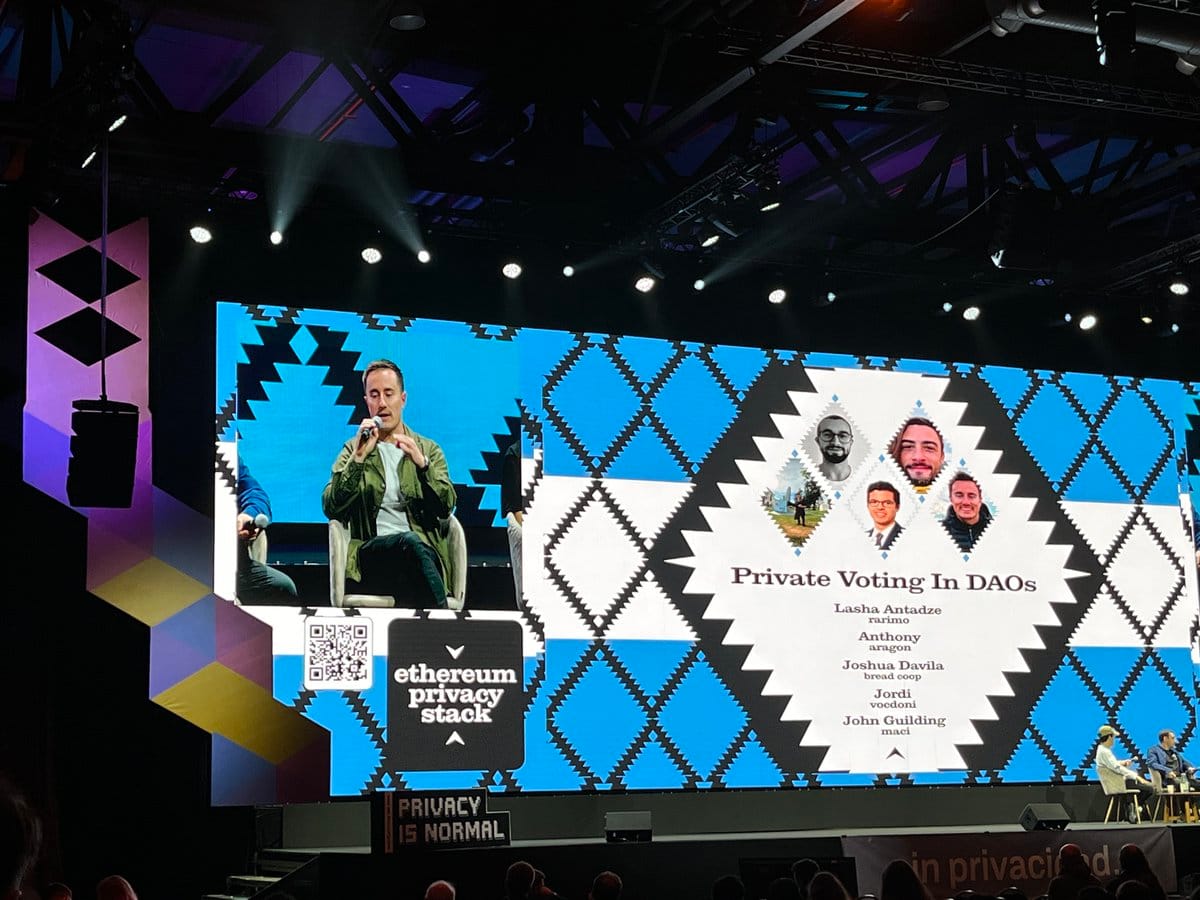
While this year’s event made clear that some sectors of the industry are consolidating and evolving, it also revealed powerful opportunities for privacy, capital coordination, and sustainable protocol, governance, and tokenomics design.
Here’s a synthesis of the notable shifts and opportunities we spotted across the conference and wider events, and where we believe Aragon can help accelerate the momentum as we head into 2026.
Privacy is a core tenant for Ethereum's future
Privacy was one of the most visible themes of the week. With Aztec’s upcoming launch, renewed attention on Privacy Pools, and the progress of projects like Status Network’s privacy-first L2, builders are investing deeply in the next generation of encrypted computation onchain. Vitalik himself spoke at length about privacy and its importance for public goods.
Although many application-layer use cases are still maturing, the ecosystem clearly recognizes that privacy will be a core tenent of Ethereum’s next decade.
At Aragon, we believe privacy systems require credible governance, permissioned workflows, and transparent upgrade paths to remain secure as they scale. The modular OSx stack, with its ability to define and enable verifiable permissions, gives privacy networks and applications a secure and auditable coordination layer for builders to continue taking privacy from theory to real infrastructure.
Institutional adoption is steadily expanding
Another clear pattern we spotted: more teams are adjusting their roadmaps to engage institutional capital, while retail participation remains steady.
Conversations repeatedly referenced the importance of New York, London, Singapore, and Hong Kong as hubs for the next wave of crypto-native financial infrastructure. As institutions begin allocating more capital onchain, they require frameworks for audits, compliance-aligned permissions, and accountable decision-making. This shift is opening up opportunities for tooling that can support structured capital flows, while maintaining decentralization.
Aragon’s governance modules and capital-management infrastructure make it possible for institutions to deploy capital programmatically, design permissions on who can execute actions, and adopt non-custodial workflows that meet both transparency standards and operational needs.
Capital deployment now requires operational governance
Many teams at Devconnect approached us directly with questions about distributing value onchain, whether for incentive programs, L2 shared-yield models, liquidity bootstrapping, or cross-chain deployments.
The ecosystem is discovering that capital flows require more than multisigs and ad hoc processes. They require governance that can scale with complexity, especially as projects experiment with shared-yield, revenue routing, and multi-party control.
Aragon can provide immediate impact with vaults, plugins, and role-based permissions that give teams the ability to automate distribution, restrict execution to specific actors, and define verifiable logic around how liquidity and incentives move across systems. As shared-yield models like Status L2 gain traction, robust capital governance will only become more essential.
DeFi is consolidating around proven models
While DeFi innovation was not the dominant story of Devconnect this year, the consolidation we’re seeing points to standardization rather than stagnation. Proven financial primitives discussed throughout the conference centered around lending, borrowing, yield aggregation, and perps.
Aave and Morpho continue to lead with meaningful innovation through new app layers and institutional integrations, while maturing L2s experiment with leverage, veTokenomics, and capital-loop strategies.
The opportunity moving into 2026 lies in creating the infrastructure that safely connects these systems, reduces operational overhead, and enables composability without sacrificing security.
Aragon’s modular governance and vaulting infrastructure can support this by offering secure execution layers for DAOs, protocols, and L2s experimenting with new incentive mechanisms or shared-yield designs.
As DeFi matures, protocols will need transparent systems that can adapt without introducing governance risk, exactly the type of upgrade-safe modularity Aragon OSx is built for.
DAOs are evolving into new organizational models
DAOs are not disappearing, they’re adapting. Many teams are embracing lighter-weight governance, delegated committees, or hybrid models that combine legal wrappers, multi-sig councils, or scoped onchain authority. This evolution is creating a more practical landscape for builders who want flexibility without giving up decentralization.
With Aragon OSx’s granular permission system and plugin architecture, organizations can adopt governance at the exact level of decentralization they need; ranging from simple role-gated actions to fully automated, permissionless governance. This makes Aragon one of the few systems that can support both emerging structures and traditional DAOs as the indusutry matures.
Demand for fairness in token launches
Another recurring theme was dissatisfaction with CEX token-launch dynamics, especially around extractive listing fees and unpredictable liquidity requirements. Because these launches still require trusted workflows, capital gating, and clearly defined authority, Aragon can serve as the infrasturcture backbone for teams running or participating in TGEs.
As we move into 2026, the opportunity lies in creating token launches with verifiable processes, transparent permissions, and the ability to manage treasury, vesting, and distribution logic without centralized intermediaries. At Aragon, we will support teams to build for these outcomes with the Value Accrual Toolkit and our vaulting systems as custom builds.
Build with Aragon in 2026
ETHDevcon Argentina made clear the next era of Ethereum will be shaped by teams that prioritize privacy, robust governance, institutional readiness, and new forms of capital coordination.
As the ecosystem consolidates around proven primitives and prepares for a wave of privacy-enabled and institutionally supported applications, the infrastructure powering this evolution must be flexible, transparent, and built to last. Aragon OSx and custom services are designed for exactly this demand and we look forward to continuing to support the Ethereum ecosystem by offering these services to teams across the industry.
Get started with Aragon OSx and reach out to discuss custom services. Let’s build durable, user-aligned tokenonmics and governance for the next cycle.