
Introducing Onchain Profiles
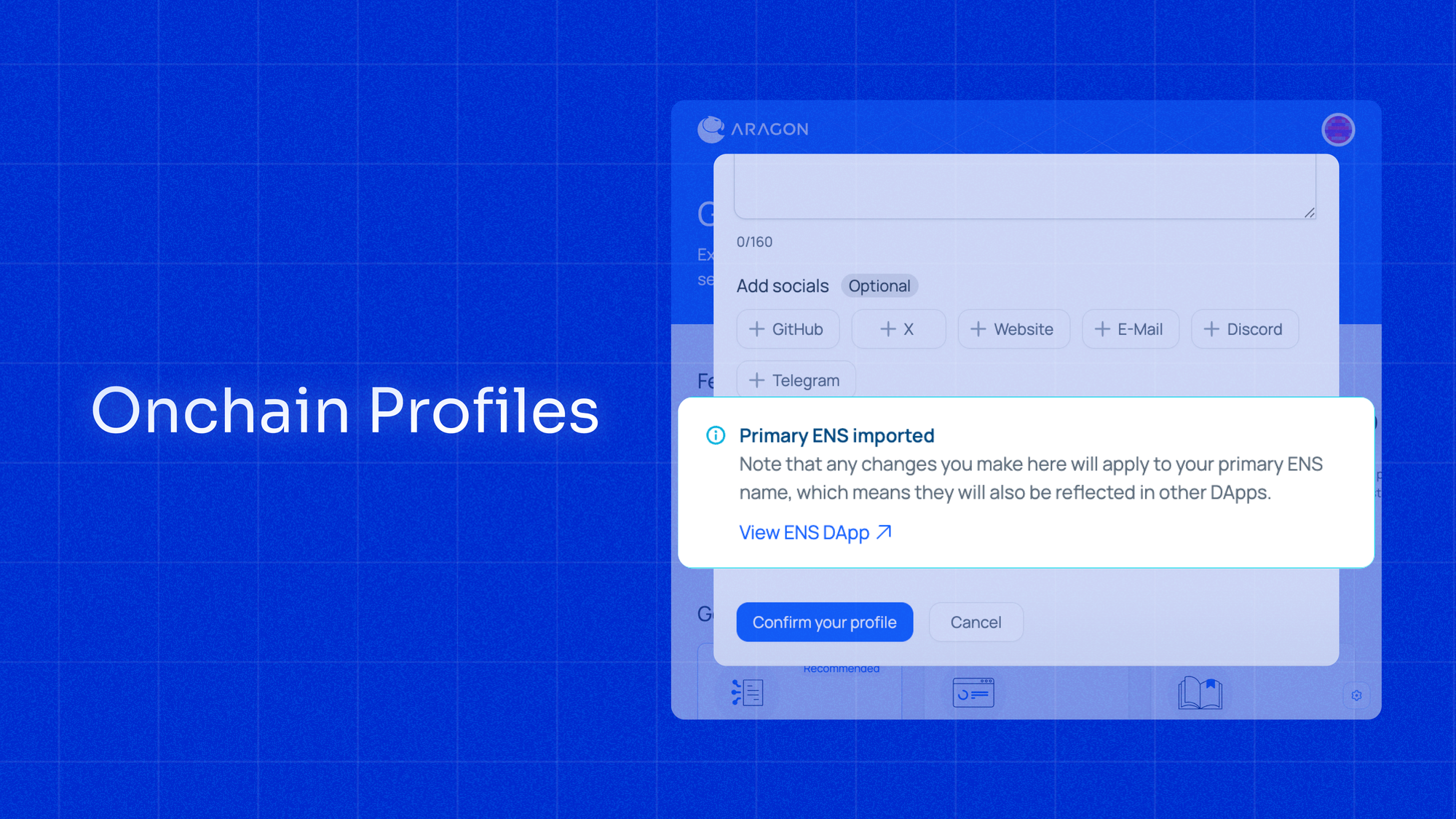
Transactions and approval flows are difficult to track with raw Ethereum addresses.
This becomes a real operational problem in access control and governance workflows. Participants are hard to recognize during critical actions, whether reviewing multisig transactions, evaluating delegates, or tracking voting activity. Some platforms offer profile systems, but those profiles typically exist inside proprietary interfaces. When teams adopt new tools, maintain multiple interfaces, or migrate providers, profile context often remains tied to a specific application rather than moving with the user.
Aragon Profiles address this by using open standards..
The Aragon app now reads and manages ENS profile records directly from Ethereum mainnet instead of maintaining a separate offchain profile database. Users can manage names, avatars, bios, websites, and social links through ENS, and governance participants can publish token-specific delegate statements using an open ENS-based record format.
For users who do not already have ENS, Aragon also supports free aragon.eth subname claims directly inside the app.
Profiles only contain information users choose to publish through ENS records associated with their wallet. Users can remain anonymous, pseudonymous, or disclose as much or as little information as they choose.
The result is a more readable access control and governance experience built on open and interoperable infrastructure.
What’s New
ENS-native profiles inside the Aragon app
The Aragon app can now resolve and display ENS profile records directly from Ethereum mainnet.
This includes:
- ENS name
- Avatar
- Bio / description
- Website
- Social links
Instead of creating another proprietary profile system, Aragon uses ENS as the underlying profile layer. Profile data remains attached to a user’s ENS name and can be reused across any ENS-compatible application.
Users can also edit these records directly from the Aragon app by signing standard ENS update transactions on Ethereum mainnet.
This improves readability across security, operational, and governance workflows without requiring teams to maintain separate profile databases to cross-reference transactions and participant activity. For example, a multisig signer reviewing a transaction can see readable profile information associated with participating wallets instead of manually verifying addresses across multiple tools.
The benefit extends beyond Aragon itself. Because profile information lives in ENS rather than an application-owned database, teams can adopt multiple interfaces, migrate between providers, or maintain fallback governance frontends without requiring users to recreate their profile information in each tool.
Token-specific delegate statements
Aragon Profiles also introduce ENS-native delegate profile records. These records are stored as ENS text records pointing to a data source containing the delegate statement.
The records allow users to publish delegate statements tied to a specific network and token. A delegate participating in multiple governance systems can maintain separate statements for different tokens without rebuilding profiles across multiple interfaces.
This structure mirrors how delegation exists onchain: delegation state belongs to the token contract itself, not to a platform-specific profile system.
Because the format is open, other applications can also resolve the same records if they choose to support them. This allows delegate context to remain portable across governance tools rather than being recreated inside each platform.
Free aragon.eth names for users without ENS
Users without an ENS name can now claim a free aragon.eth subname directly from the Aragon app.
During onboarding, the app checks whether the connected wallet already has a primary ENS name. If not, users can claim an aragon.eth subname.
Users can then set that name as their primary ENS identity and use it across ENS-compatible applications.
This removes a common onboarding gap where governance participants want readable identity inside governance interfaces but have never registered ENS themselves.
Get Started
Aragon Profiles are now available in the Aragon app.
Connect a wallet to create or manage an ENS-native profile, claim an aragon.eth name if needed, and configure delegate statements directly from the app.
Teams improving signer coordination or migrating their governance system can also reach out to discuss implementation support.