
Verifiable Secret Ballots with Interfold and Aragon
CRISP is now available through an implementation built on Interfold and Aragon, making verifiable secret ballots private, while the result can be publicly verified without relying on a single tallying authority.
Co-authored by Interfold and Aragon.
Secret ballots are a basic requirement of democratic systems, but they are difficult to implement onchain without suboptimal tradeoffs.
All private voting systems compromise on trust or verifiability somewhere in the process. For example, a trusted coordinator or trusted execution environment may process the private votes, control decryption, or determine how the final result is made available. Encryption protects the contents of individual ballots, but it does not by itself distribute control over how those ballots are tallied and how the final result is decrypted.
Interfold’s Coercion-Resistant Impartial Selection Protocol, or CRISP, takes a different approach. Participants submit encrypted votes, the tally is computed over encrypted ballots, and only the aggregate result is decrypted once the required threshold conditions are met. Individual ballots remain private, while the result can be publicly verified without relying on a single tallying authority.
CRISP is now available through an implementation built on Interfold and the Aragon OSx framework, making verifiable secret ballots available in testnet form for Aragon-based organizations.
What’s New
Private ballots with distributed trust and publicly verifiable results
Participants submit encrypted ballots, CRISP computes the tally over encrypted inputs, and only the approved aggregate result is decrypted once the required threshold conditions are met. Individual ballots remain private from other voters, administrators, infrastructure operators, and ciphernodes.
Distributed control over tallying and decryption
For each computation, Interfold selects a committee of independent network operators, called ciphernodes, through sortition. The committee participates in setup and threshold decryption for that ballot, so no single operator can decrypt ballots or release the result unilaterally.
A modular implementation for Aragon OSx
CRISP is integrated with Aragon OSx through a dedicated governance plugin. DAOs can add it alongside existing OSx plugins, giving organizations a secret-ballot mechanism for decisions where individual choices should remain private.
How It Works
CRISP stands for Coercion-Resistant Impartial Selection Protocol. It coordinates the ballot through a bounded execution flow that combines encrypted ballots, verifiable tallying, and threshold decryption.
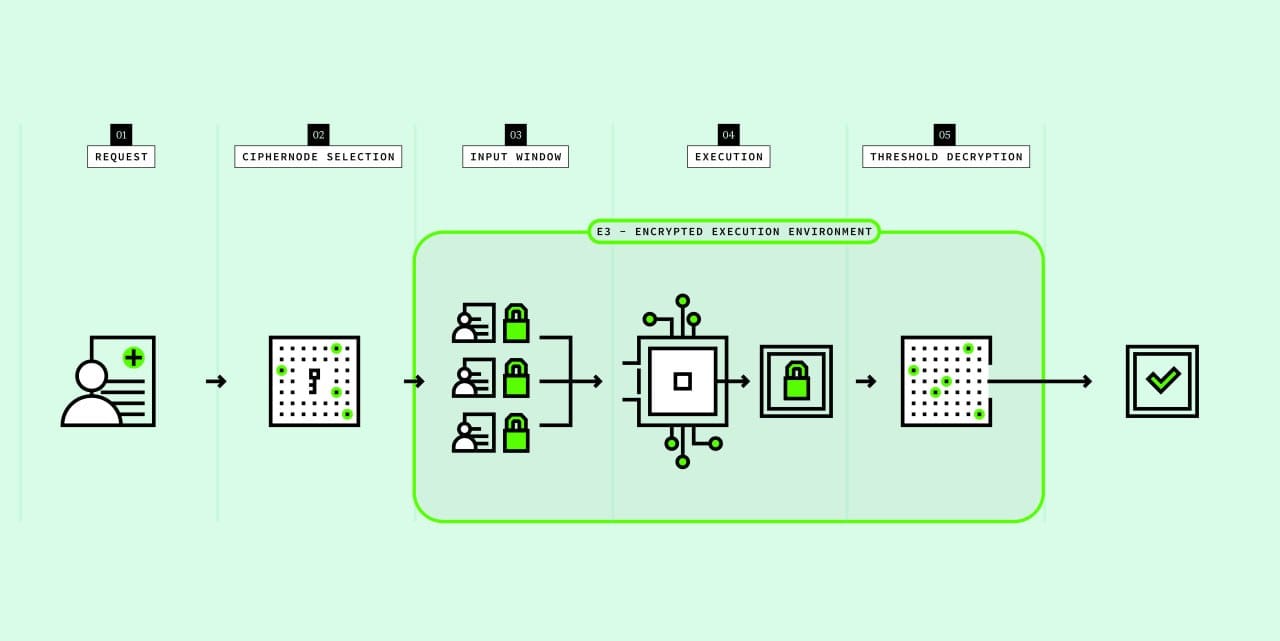
1. The vote defines the computation
When a secret ballot is created, its rules define the eligible participants, voting period, available choices, tallying logic, and conditions for decrypting the result.
Interfold creates an Encrypted Execution Environment, or E3, for that specific vote. The E3 exists only for the duration of the computation. It receives encrypted ballots, applies the defined tallying logic, and closes after the permitted result has been made available.
2. A ciphernode committee is selected
A committee of independent ciphernodes is selected from the Interfold network for the vote.
The committee generates the shared cryptographic material used to encrypt ballots and later decrypt the result. Control is distributed across its members, so the process does not depend on one operator holding a complete decryption key.
3. Participants submit encrypted ballots
Eligible participants encrypt their choices and submit them during the voting window.
The votes remain encrypted throughout execution. Other voters, the organization administering the vote, and individual ciphernodes cannot inspect the submitted choices.
4. The tally is computed on encrypted data
CRISP uses fully homomorphic encryption to perform the defined tally over encrypted ballots.
Multi-party computation and zero-knowledge proofs support distributed key operations and verification of the process. Together, these mechanisms allow the ballot to be processed without exposing individual votes.
5. The result is made available through threshold decryption
Once the voting period has ended and the release conditions have been satisfied, the ciphernode committee performs threshold decryption of the permitted result. The final tally can then be published and verified, while individual ballots remain private.
6. Approved onchain actions are executed with Aragon OSx
The CRISP plugin can be installed on an Aragon OSx DAO and connected to its onchain execution permissions.
When a vote includes an executable payload and satisfies the DAO’s approval requirements, the approved action can be executed through the DAO.
What’s Next
The CRISP plugin built on Aragon is the first secret-ballot solution of its kind.
Future work will focus on making the integration easier to deploy, extending the governance workflows supported by the plugin, and exploring real-world governance use cases.
Get Started
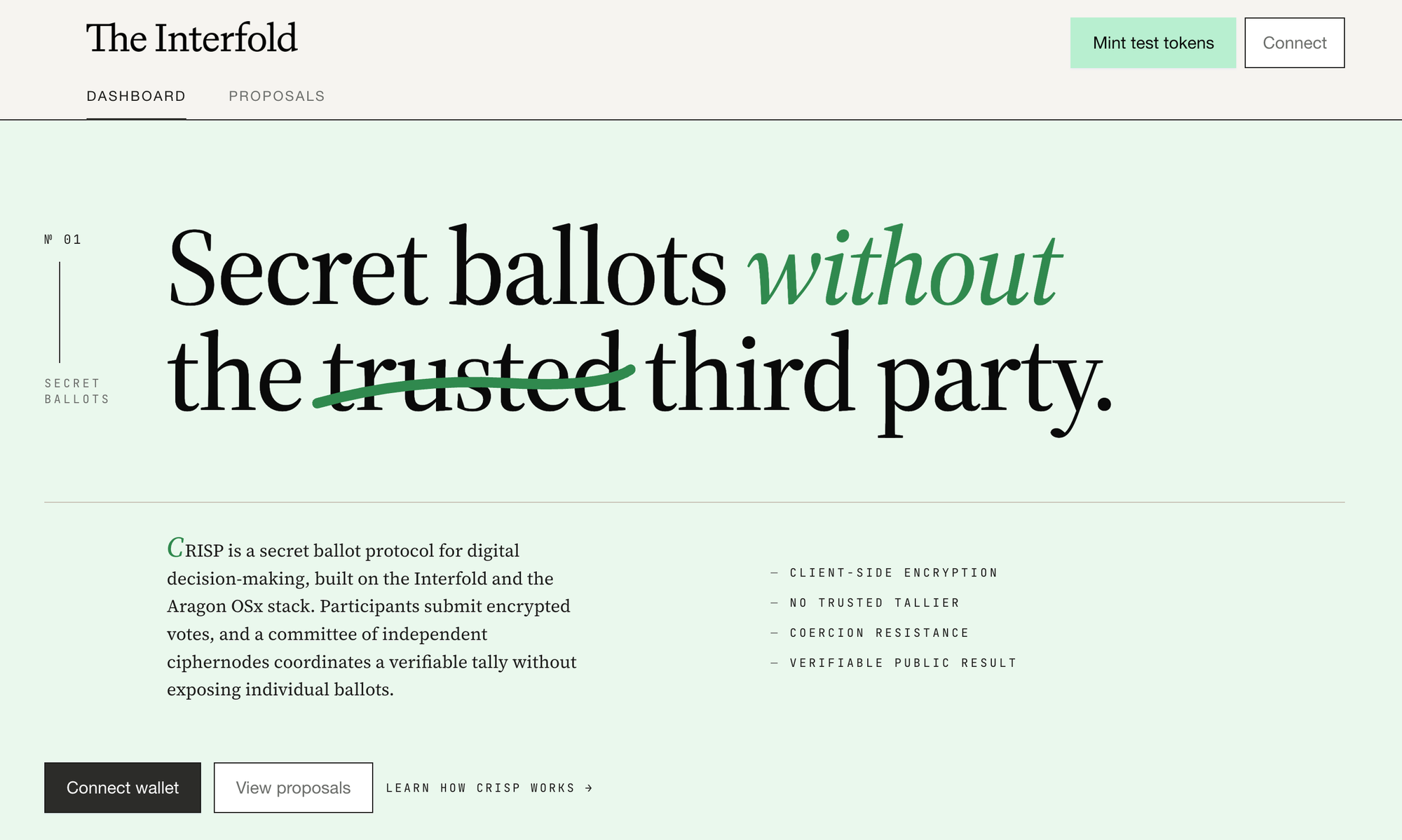
The secret-ballot implementation is available on testnet. Production deployment paths will follow Interfold’s network rollout.
Teams exploring private voting or confidential governance workflows can try out the demo or contact Aragon to explore deployment options.