
Introducing Automated Buybacks
A set of flexible primitives for building, governing, and executing buyback programs onchain.
A set of flexible primitives for building, governing, and executing buyback programs onchain.
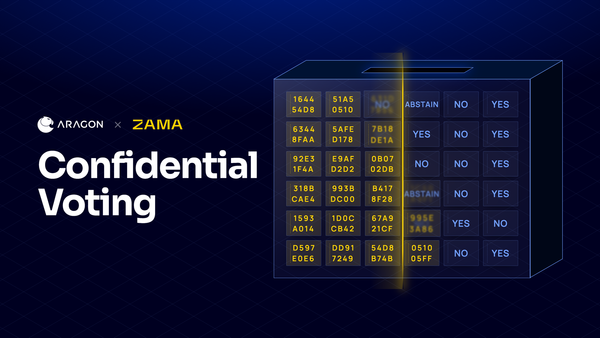
Introducing Confidential Voting, an Aragon OSx plugin built on Zama Protocol. Votes remain encrypted while counted, with the familiar Aragon voting experience. Programmable confidentiality lets projects define what can be decrypted, by whom, and under what conditions.

CRISP is now available through an implementation built on Interfold and Aragon, making verifiable secret ballots private, while the result can be publicly verified without relying on a single tallying authority.

Is your onchain contract actually the audited code? For every deployment and upgrade, teams need to verify that the code running onchain is the code they reviewed, approved, and audited. A smart contract audit reviews a codebase at a specific point in time. Auditors read a particular Git commit, evaluate

Transactions and approval flows are difficult to track with raw Ethereum addresses. This becomes a real operational problem in access control and governance workflows. Participants are hard to recognize during critical actions, whether reviewing multisig transactions, evaluating delegates, or tracking voting activity. Some platforms offer profile systems, but those profiles

Organizations don’t normally operate from a single undifferentiated treasury. Different funds serve different purposes and involve different stakeholders. An operations team may need a dedicated budget for payroll and vendors. Protocol revenue may be allocated to rewards and incentives. Other funds may be reserved for grants, buybacks, or long-

Every transaction once required a governance proposal. Now they can execute according to rules governance defines but never has to touch again. Last year, we planted our flag in the sand: if one-size-fits-all decentralized governance frameworks did not get replaced with something that could more flexibly adapt

2026 will determine whether crypto-native tokens become real, investable assets. Learn why ownership tokens, enforceable rights, and value accrual matter.

If we want tokens to be investable and valuable assets, there is one ingredient we can’t keep dodging: ownership.

ETHDevcon Argentina made clear the next era of Ethereum will be shaped by teams that prioritize privacy, robust governance, institutional readiness, and new forms of capital coordination.

Aragon is building pre-deposit vaults for Status Network, allowing users to contribute liquidity, stake assets, and more ahead of mainnet launch.

Aragon and Enclave are deepening the privacy spectrum in onchain governance, introducing verifiable secret ballots that make voting both confidential and provably secure. Privacy is essential to meaningful governance. It gives participants the freedom to express their views without pressure, ensuring outcomes reflect genuine consensus rather than influence. Earlier this

Over the past two months, the Aragon team shipped major upgrades designed to make governance simpler, safer, and more composable.

Learn how Aragon is safeguarding DeFi assets on Morpho for the Ethereum Foundation and how the Guardians experience is improving with LockToVote, a new governance plugin on Aragon OSx.

Morpho Vaults V2 set a new standard for onchain asset curation. Alongside it, depositor oversight is upgrading too. Together with Morpho, we’ve built Guardians V2, a new system that makes it easier for vault depositors to exercise their onchain veto power, powered by Aragon’s LockToVote plugin. Oversight for

ve-lockers and gauges became the cornerstone of aligned tokenomics in DeFi. Spearheaded by Curve, they set the standard for rewarding long-term commitment and directing incentives where the community values them most. Now, YieldBasis, led by the team behind Curve and the original ve and gauge vision on Aragon,

Distributing capital has been expensive, labour-intensive, full of legal uncertainty, and rife with mistakes. Today, we’re changing that. Incentives and rewards are the lifeblood of onchain ecosystems. They drive liquidity, attract builders, and align stakeholders. But distributing capital onchain has never been easy. Most projects today rely on

Value accrual is the engine of sustainable growth for ecosystems. It aligns incentives, strengthens networks, and creates a feedback loop where usage drives value and value flows back to participants. Obvious as it may sound, most ecosystems struggle to design these systems. We at Aragon set out to change this,

Set up limited-liability wrappers for the wallets and roles that run your protocol. No paperwork, no slowdown. For years, decentralized organizations have been stuck in regulatory limbo. Projects that move at the speed of code often rely on opaque, off‑chain entities that slow them down and create unnecessary

The past month focused on further unlocking the true power of OSx for onchain organizations, with new updates across governance design, proposal creation, and UI features making it easier than ever to build exactly what your org needs. From private, encrypted voting to modular permissions and streamlined proposal creation, the

Products
Aragon and the team behind MACI (Minimum Anti-Collusion Infrastructure) have joined forces to bring private voting at scale to onchain organizations, with development currently underway.

No-code separation of powers: grant precise, function-level permissions without writing a line of code. The ideal organization spreads decision-making so one process isn't responsible for everything. Onchain, however, most teams are forced to spin up a single, all-powerful contract (like a multisig or a

Products
Last month brought key enhancements across app UX, new chain support, and core infrastructure improvements. June closed out the quarter with continued progress toward our mission: making it easier than ever to build secure, scalable onchain organizations. The month saw a wide range of updates across Aragon OSx, the Value

Products
We roundup our product updates for the month of May, which saw a leap forward in modular governance.